
Phenolic Film Surfaces: Reading the Specification Sheet
A phenolic film surface is a promise written in grams per square metre and reuse cycles. The specification sheet for formwork plywood lists the film type, the film weight, the core, the adhesive and the sizes, and a buyer who can read those five lines can predict how the panel will behave on a concrete pour.

Key takeaways
- Three film surfaces are available: dark brown, black and anti-slip.
- Two film weights are published: 165 g/㎡ for the heavy smooth option and 130 g/㎡ for the lighter grade.
- Cores run birch, eucalyptus, acacia, white hardwood, rubber and combi, each with a published description.
- The published reuse ceiling for high-grade film faced plywood reaches 10–20 pours on concrete formwork.
What a specification sheet should list
The sheet exists to remove adjectives. 'Durable', 'strong' and 'heavy-duty' mean nothing that a site can check, while film weight, core species, adhesive class and panel length can all be verified with a datasheet and a tape measure. A mill that publishes a sheet with those five lines is inviting the buyer to check its work, which is the strongest signal a supplier can send.
The sheet also protects the buyer's own team. When the specification is written down, the site crew knows what arrived, the procurement team knows what was ordered, and the two can be compared without a meeting. In practice, most disputes about formwork panels are disputes about what was specified, and a complete sheet makes them rare.
Film types and film weight
Three film surfaces are available: dark brown, black and anti-slip. The dark brown and black films are smooth and selected for the concrete finish they produce; the anti-slip surface is textured for grip on walkboards and platforms where a smooth film would be slippery. The choice is functional rather than cosmetic, and it belongs in the specification rather than in a site instruction.
Film weight is published as 165 g/㎡ for the smooth heavy option and 130 g/㎡ for the lighter grade. The weight acts as a proxy for abrasion resistance: a heavier film endures more pours before the surface contacting the concrete begins to wear. A buyer planning a multi-pour project should ask which weight the quotation includes, because the two grades are not interchangeable across a long programme.
Core options behind the film
The core carries the load and the film carries the concrete. Six core options are available — birch, eucalyptus, acacia, white hardwood, rubber and combi — and the client's own descriptions assign each a distinct role: eucalyptus provides the highest compression resistance and bending strength; acacia is a dense hardwood with a long service life; white hardwood, covering species like Bodhi, balances mechanical strength against cost; and combi blends species to trade off strength, weight and price.
The combi option deserves attention from volume buyers. A eucalyptus-and-acacia or hardwood-and-softwood hybrid can be specified where a solid hardwood core would be wasted on a panel that never sees a bridge deck. Matching the core to the load case is how a programme keeps the strength it needs without paying for strength it will not use.
Adhesives and glue classes
The adhesive catalogue runs E0, E1, E2, MR, WBP and Phenolic Dynea. For formwork the relevant systems are the phenolic ones: WBP and Phenolic Dynea describe glue lines that stand up to repeated contact with wet concrete and the weather exposure between pours. The emission-controlled grades, E0 and E1, belong to interior products where the glue is chosen for the air a room breathes.
The glue class also signals how the panel was pressed. A phenolic system is cured under heat and pressure in a process that leaves the panel dimensionally stable, which is why the same catalogue can serve both formwork and marine-adjacent work. Asking for the glue class in the specification is asking how the panel was made, not just what it is made of.
Sizes and custom lengths
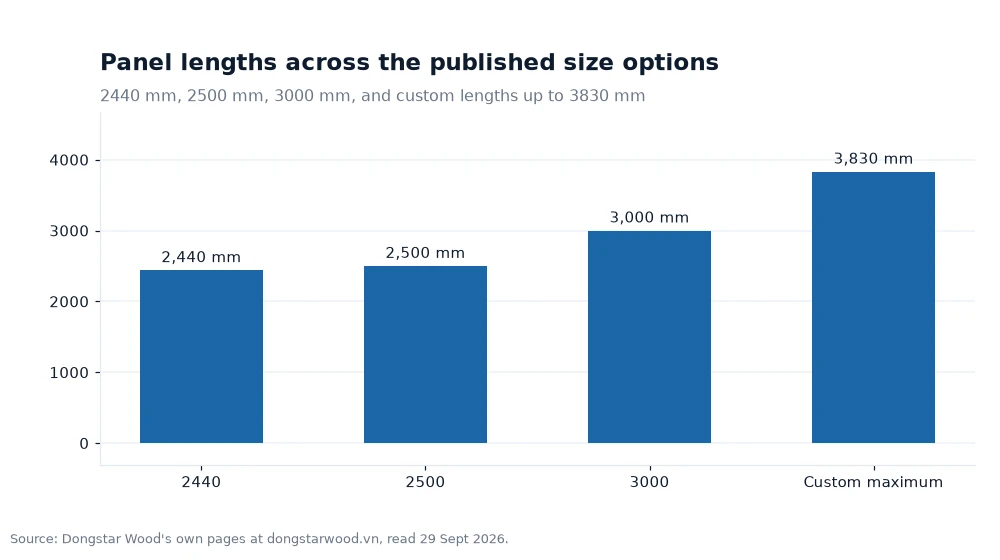
Standard sheet dimensions run to 1500 × 3000 mm at the top of the list, with 1250 × 2500 mm and 1220 × 2440 mm beside it, and bespoke panels available up to 1830 × 3830 mm. Most formwork systems are served by the three standard formats, while the custom window accommodates projects whose geometry falls outside a standard sheet. A buyer planning a large pour should verify the custom maximum early, because a formwork design that assumes a 4 m panel may require redesign.
Panel length drives the layout of the formwork itself. A 3000 mm sheet covers a wall in fewer joints than a 2440 mm sheet, and each joint is a place where concrete can leak and time can be lost. The size line on the specification sheet is therefore a productivity number before it is a logistics number.
Reuse expectations on site
The published reuse figure is what separates a formwork panel from a consumable: high-grade film faced plywood achieves 10–20 pours on concrete formwork. That span is a planning assumption rather than a promise about any individual panel — the actual count depends on edge protection, handling and the finish the concrete leaves on the film.
Reuse is where the specification pays back. A panel that survives ten pours costs a tenth as much per pour as a panel that survives one, and the arithmetic only works if the edges are sealed and the film is the heavier weight. The specification sheet is what makes the reuse claim checkable: film weight, core and adhesive together determine whether the 10–20 range is realistic for a given project.
| Specification line | Published options | What it determines |
|---|---|---|
| Film surface | Dark brown, black, anti-slip | Concrete finish and grip |
| Film weight | 165 g/㎡ smooth; 130 g/㎡ | Abrasion resistance across pours |
| Core | Birch, eucalyptus, acacia, white hardwood, rubber, combi | Load capacity and panel life |
| Adhesive | E0, E1, E2, MR, WBP, Phenolic Dynea | Bond behaviour in wet conditions |
| Sizes | 1220 × 2440; 1250 × 2500; 1500 × 3000; custom to 1830 × 3830 mm | Formwork layout and joint count |
Worked example: reuse arithmetic for one sheet
Each 1250 × 2500 mm sheet measures 1.25 m × 2.5 m, giving 3.125 m² of concrete contact per face. With the published reuse span, a single panel covers 31.25 m² at the lower end or 62.5 m² at the upper end when edges are sealed and the heavier film is chosen. The difference between those two totals is what edge care and film weight deliver.
Scale the arithmetic to a wall. A 100 m² formwork face requires 100 ÷ 3.125 = 32 sheets per pour. Ten pours means 320 sheet-uses, which 32 panels can cover provided every one survives the full span. The specification sheet is what converts that condition into a documented expectation rather than a hope.
Frequently asked questions
What does film weight tell a buyer?
Film weight acts as a proxy for abrasion resistance: 165 g/㎡ is the smooth heavy option and 130 g/㎡ the lighter grade. For a multi-pour project the heavier film is the one that keeps its surface across the full reuse range.
Which cores sit behind the film?
Birch, eucalyptus, acacia, white hardwood, rubber and combi. Eucalyptus delivers the highest compression resistance, acacia is a dense hardwood with a long service life, white hardwood is stable and cost-effective, and combi blends species to balance strength, weight and cost.
How many reuse cycles should a project plan for?
Reuse for high-grade film faced plywood is published at ten to twenty pours on concrete formwork. Budget the project on the lower figure, and treat the upper figure as the reward that careful edge protection and handling deliver.
From sheet to site order
A specification sheet earns its place when it travels to the site with the goods. Film Faced Plywood from this range covers dark brown, black and anti-slip surfaces across six core options. Compare the anti-slip range where grip matters more than concrete finish, and the economical black film range where the reuse range is shorter and the budget is tighter. The right panel for a project is the one whose published sheet matches the load, the pour count and the finish.
Data points in this article originate with the mill's website reviewed on 29 September 2026[1].