
Quality control in a kids-safe perfume pack is not a final inspection; it is five checkpoints, each of which leaves evidence. Incoming materials verify what arrived, compounding verifies what was made, filling verifies what was put in the bottle, closure performance verifies the safety case, and pre-shipment verifies what is about to leave. Skip one and the others lose their meaning — a perfect final inspection cannot recover from a closure that was never tested.
Key takeaways
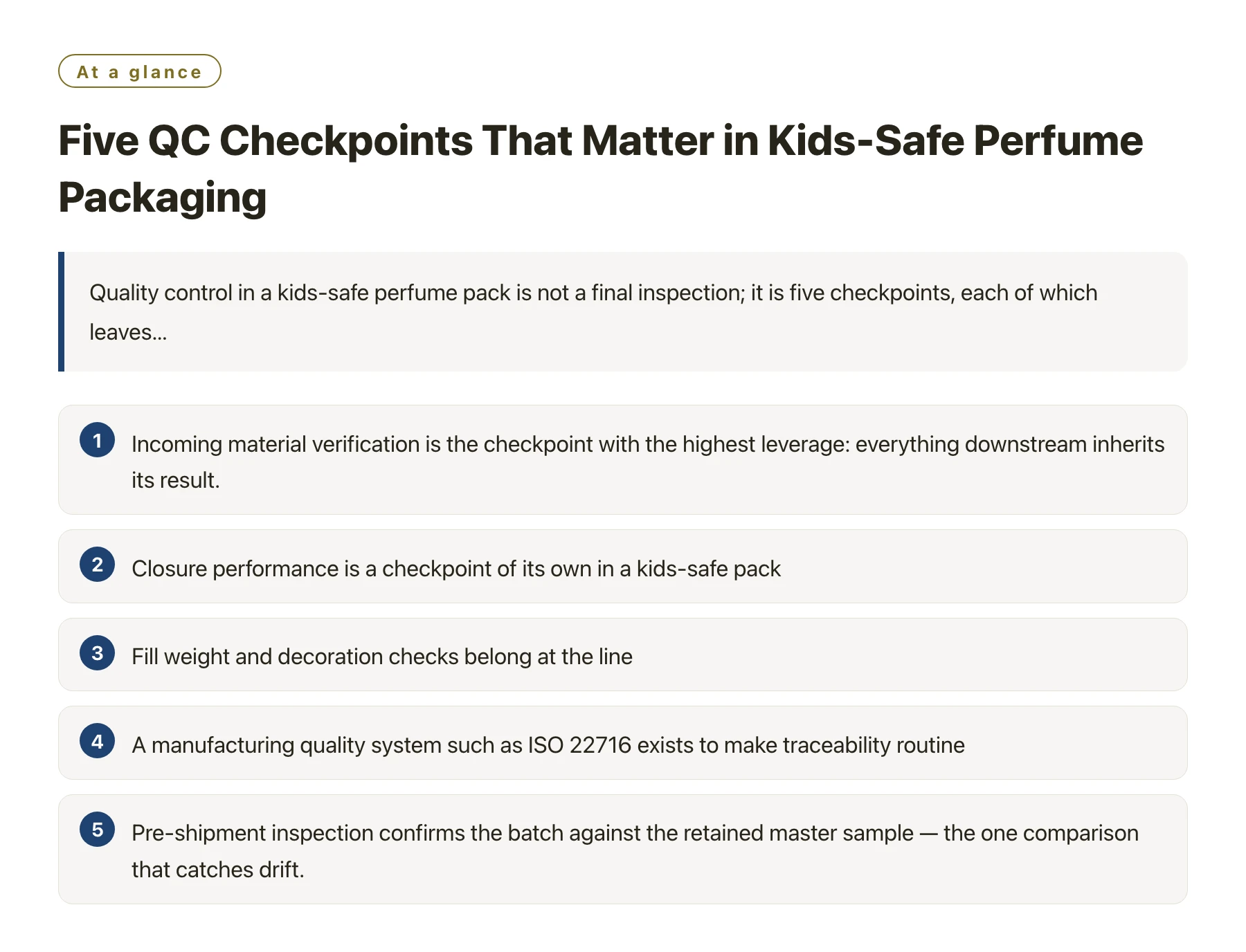
- Incoming material verification is the checkpoint with the highest leverage: everything downstream inherits its result.
- Closure performance is a checkpoint of its own in a kids-safe pack, and it is verified against a standard rather than by feel.
- Fill weight and decoration checks belong at the line, where a defect can still be corrected rather than after packing.
- A manufacturing quality system such as ISO 22716 exists to make traceability routine, not to replace the checks themselves [1].
- Pre-shipment inspection confirms the batch against the retained master sample — the one comparison that catches drift.
QC is often described as a department, but in a well-run fragrance project it is a sequence of gates: each one decides whether the batch continues, and each one leaves a record. For a kids-safe pack, two of the five gates carry extra weight, because the safety case depends on them: incoming materials and closure performance.
This article walks the five checkpoints in the order the product meets them, with the evidence each one should produce and the failure mode it exists to catch.
The five checkpoints in production order
The sequence matters more than any individual check, because each gate assumes the previous one passed. That is why a supplier who can show you a complete trail — not just a passed final inspection — is showing you a process rather than a result.
Checkpoint 1: incoming materials
Every batch of fragrance material, solvent, glass and closure is checked against its specification on arrival: identity, documentation, condition and, where relevant, the certificate trail. This gate has the highest leverage of the five, because a material that enters the process unverified contaminates everything downstream. For a kids-safe line, the closure and glass arriving at this gate should match the tested specification exactly — a substitution here invalidates the safety case silently.
Checkpoint 2: compounding
Compounding is where the formula becomes a batch, and the checkpoint verifies that the batch matches the reference: weights, order of addition, mixing parameters and the resulting appearance and odour against the standard. The record of this gate is what allows a later question — was this batch within specification? — to be answered with evidence rather than memory.
Checkpoint 3: filling and assembly
Fill weight, seal integrity, decoration alignment and closure torque are line checks. They are the fastest gates and the easiest to skip under production pressure, which is exactly why they are scheduled rather than improvised. A defect caught here costs a correction; the same defect caught after packing costs a repack; caught by a customer, it costs the listing.
Checkpoint 4: closure performance
In a kids-safe pack this is a distinct gate: the closure is checked against the tested specification — the component, its torque or engagement behaviour, and the evidence that the tested version is the one being used. This is where a supplier that switched to an untested lookalike cap is caught. The gate exists precisely because the substitution is invisible on the shelf.
Checkpoint 5: pre-shipment inspection
The last gate compares the finished batch against the retained master sample: appearance, fill, decoration, labelling and packing. It is the only checkpoint that sees the product as the customer will, and it is the one that catches gradual drift across a production run. Its report is also what an importer or retailer will ask for first.
Checkpoint, evidence and the failure it catches
| Checkpoint | Evidence it leaves | Failure it catches |
|---|---|---|
| Incoming materials | Material check records, certificates | Unverified or substituted inputs |
| Compounding | Batch record against formula reference | Out-of-spec batches and drift |
| Filling and assembly | Fill weight data, torque and decoration checks | Line defects before packing |
| Closure performance | Closure specification and test evidence | Untested or substituted closures |
| Pre-shipment | Inspection report versus master sample | Accumulated drift across the run |
The table also works as a supplier questionnaire: ask which of the five gates the factory documents, and ask to see one example of each record. The shape of the answer tells you how the factory thinks about quality.
Turning checkpoints into auditable evidence
A checkpoint that produces no record is a habit, not a control. The point of writing the evidence down is that it converts a factory's internal discipline into something a buyer, an importer or a regulator can check months later. Cosmetics GMP frameworks such as ISO 22716 are built around exactly this idea: they make traceability and documentation routine rather than exceptional, and testing services in the cosmetics sector are organised around verifying that the routine holds [1].
For a kids-safe pack, the practical consequence is that two of the five records carry disproportionate weight. The incoming-material record protects the safety case for the closure and the glass; the closure performance record proves the safety case to anyone who asks. If you can only insist on two of the five gates being documented, insist on those two.
Buyers also ask where the checkpoints sit relative to the manufacturer's own methods. A fragrance R&D and production operation with its own laboratory can run several gates in house, which shortens the loop between a failed check and a corrected batch. Where a gate is outsourced — often the closure test itself — the manufacturer should still own the result, because it is the manufacturer's name on the batch record.
There is one more perspective worth adopting: the checkpoints are as much about the glass and the pack as about the juice. A brand commissioning fine fragrance manufacturing (fine fragrance manufacturing) will find that the pack gates dominate the complaint profile — chipped decoration, leaking seals, stiff pumps — long before the scent does. Inspection is where those become visible.
And if you want to understand how a partner treats its process before you commit, start with what it publishes about itself: the way a factory describes its scope and certifications on its own site — for example the information presented on the Xuelei's official site — is a preview of how it will document your batch records. A firm that stands behind the factory (the company behind the factory) and documents its systems publicly tends to document its batches privately too. Ask to walk one batch record end to end at the supplier visit; the willingness to do that is the real qualification.
What to do when a checkpoint fails
Treat a failed check as information, not as a crisis — the cost of failure at gate one is a conversation, at gate five it is a shipment. The productive response is to record the failure, identify the gate that should have caught it earlier, and correct that gate. Factories that improve at this become reliable; factories that skip past failures to hit a date become expensive.
Ask for one example of each of the five records on your next supplier visit. It takes twenty minutes and tells you more about a factory's quality culture than any certificate on the wall — certificates show what was audited, records show what happened.
Sources
- SGS: Cosmetics, Personal Care & Household Testing —— Testing, inspection and certification services for cosmetics and personal care, including microbiological, stability and safety testing aligned with cosmetics GMP.
Frequently asked questions
How is a closure checked in production?
By verifying that the component used matches the tested specification and that its engagement behaves as specified — torque or opening behaviour measured against the standard, with the component identity traceable to the test report. Looking at the cap is not a check; matching it to the tested version is.
Do I need a third-party inspection for every order?
Not necessarily. For a first order, and for any order where the pack is new, an independent pre-shipment inspection is worth the cost because it compares the batch against your retained master sample with fresh eyes. As the relationship matures, in-house checks with spot independent audits can be enough.
What is the most common QC failure in kids-safe packaging?
Substitution — a closure, glass or label that is close to the approved specification but not identical, usually introduced to protect a date or a margin. It is invisible on the shelf, which is why incoming-material verification and closure performance checks exist as separate gates.
How does ISO 22716 relate to these checkpoints?
It is the framework that makes documentation and traceability routine for cosmetics manufacturing, so the checkpoints above are the practice and the standard is the expectation around them. A certificate tells you the system was audited; the batch records tell you the system ran.
What should the pre-shipment report contain?
At minimum: a comparison against the retained master sample, fill weight data, decoration and label verification, packing and carton checks, and photographs of the finished goods. It should reference the batch and the inspection date so it can be matched to your order file.